
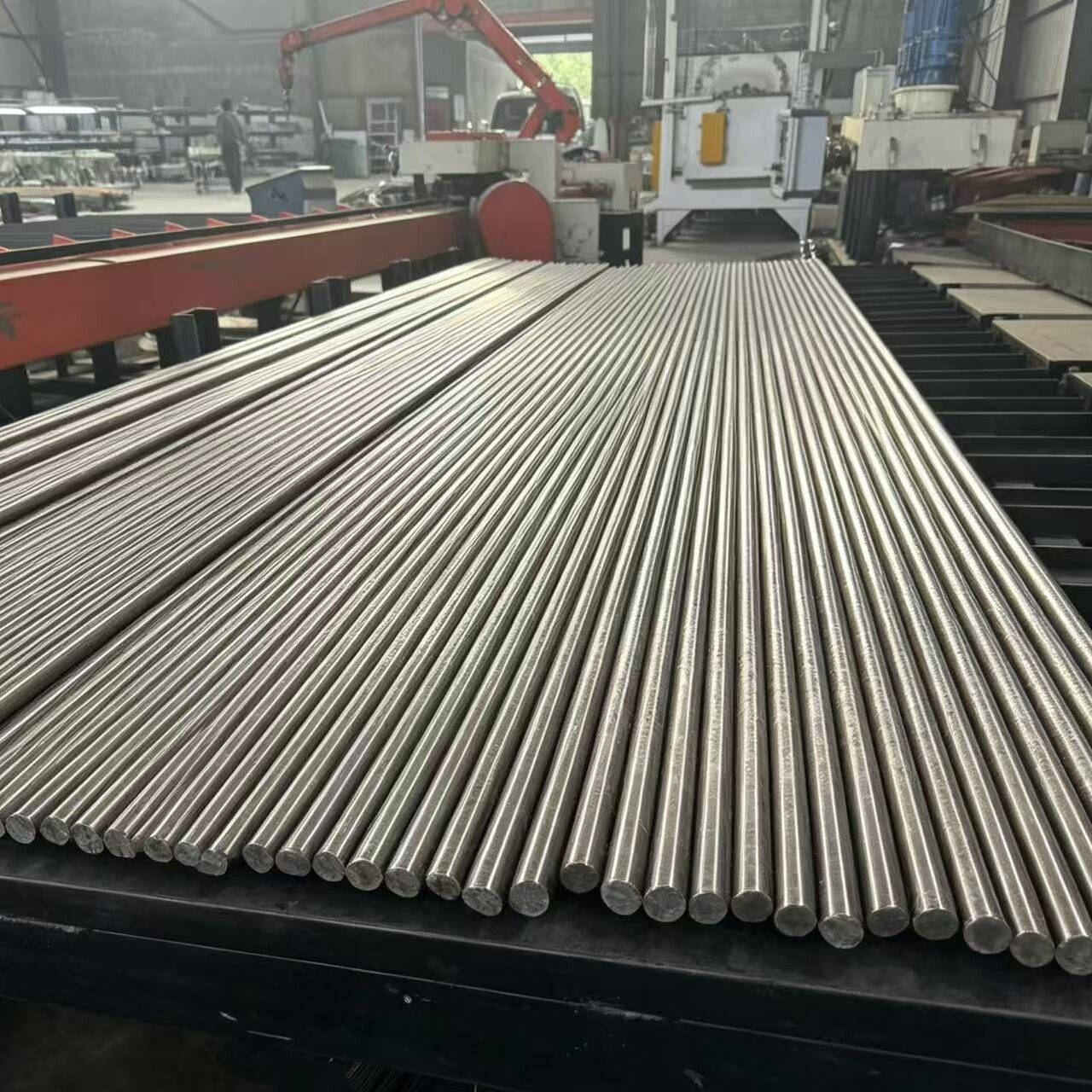
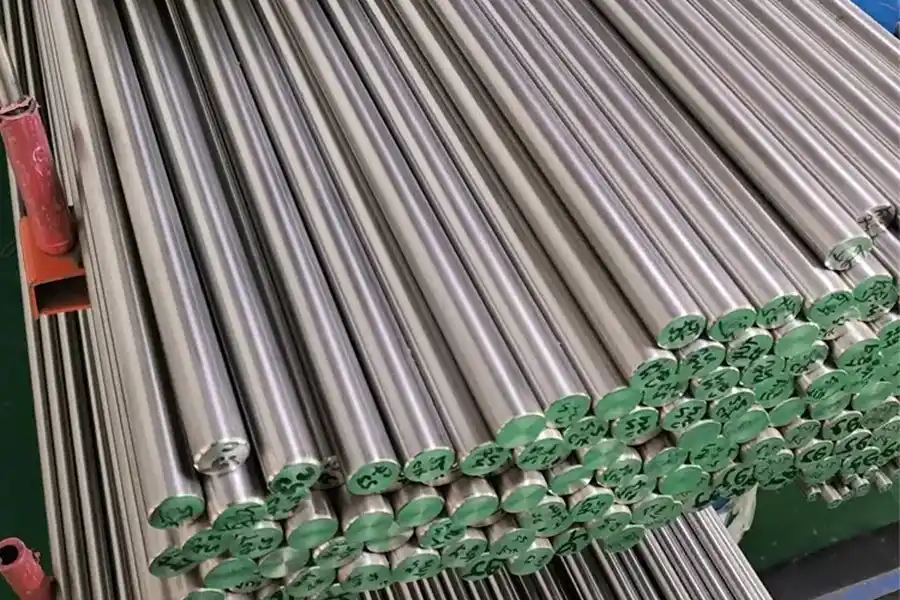
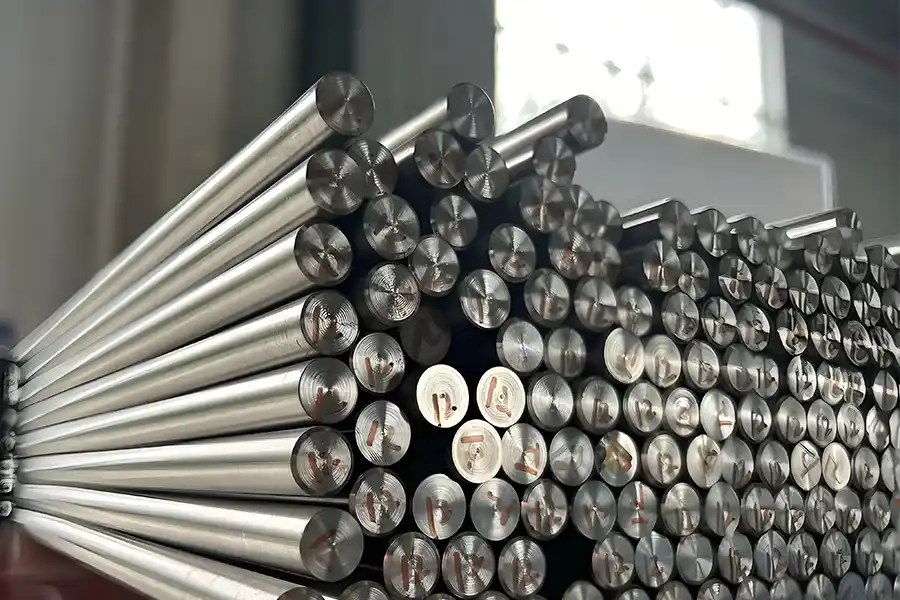
What titanium Rod is, and how it is made
Titanium rod is solid titanium stock produced by forging, hot rolling or cold drawing a remelted ingot into a straight section. It is the starting form for almost every machined titanium part, and the grade you specify determines its strength, its corrosion behaviour and how it responds to heat treatment.
Commercially pure titanium, Grades 1 through 4, differs from one grade to the next almost entirely in oxygen content. Oxygen sits in interstitial solution and raises strength directly: Grade 1 at 0.18 percent maximum oxygen gives a 240 MPa minimum tensile strength, while Grade 4 at 0.40 percent reaches 550 MPa. Grade 2, with 0.25 percent, lands in between at 345 MPa and accounts for most of the rod we ship, because it keeps the corrosion resistance and weldability of the pure grades at a strength level that is actually useful in pressure-boundary work.
Alloyed grades work differently. Grade 5, Ti-6Al-4V, is an alpha-beta alloy strengthened by aluminium and vanadium and capable of being heat treated. Annealed it gives 895 MPa minimum tensile strength; solution treated and aged it reaches around 1100 MPa. That combination, at a density of 4.43 g/cm³, is why Ti-6Al-4V accounts for more than half of all titanium alloy consumed worldwide.
Between those two families sit the near-alpha grades, which trade some strength for specific corrosion or forming behaviour. Grade 7 adds 0.12 to 0.25 percent palladium to a Grade 2 chemistry and solves the one genuine weakness of unalloyed titanium: attack in reducing acids and in crevices below pH 3. Grade 12 achieves most of the same result with 0.3 percent molybdenum and 0.8 percent nickel, at considerably lower cost since neither element is a precious metal. Grade 9, Ti-3Al-2.5V, is the alloy buyers reach for when a part needs more strength than Grade 2 but has to be cold formed, which Grade 5 does not tolerate well.
From ingot to rod
| Melting | Double or triple vacuum arc remelt (VAR) from certified titanium sponge. Electron beam cold hearth melting is used for implant grades to remove hard alpha inclusions. |
| Breaking down | Ingot forged to billet above the beta transus to refine the as-cast structure. |
| Finishing | Billet forged or hot rolled to rod below the beta transus, then annealed, descaled and straightened. |
| Cold finishing | Smaller diameters are peeled, turned, ground or cold drawn to reach h9 tolerance and Ra 0.8 µm. |
| Inspection | Ultrasonic and penetrant testing, dimensional check, then certification per heat. |
Choose a grade and see its full data
Minimum mechanical values are taken from ASTM B348 for rod in the annealed condition. Typical tensile ranges are our mill averages and will vary from heat to heat, so treat them as planning figures and rely on the certificate for acceptance.
Gr1
R50250
Gr2
R50400
Gr5
R56400
Gr7
R52400
Gr9
R56320
Gr12
R53400
Mechanical properties — Grade 1
Tensile min
240
MPa · ASTM B348
Yield min
170
MPa · 0.2% offset
Elongation min
24
% · in 4D or 50 mm
Density
4.51
g/cm³ · room temperature
The softest and most formable of the unalloyed grades. Chosen where deep drawing, spinning or severe cold forming matters more than strength.
Typical applications
- Chemical linings and cladding
- Heat exchanger tube plates
- Architectural and jewellery stock
- Anode baskets for plating lines
Chemical composition limits for Grade 1 (R50250) per ASTM B348, weight percent
| Element | Limit, % |
| Oxygen | 0.18 |
| Iron | 0.20 |
| Carbon | 0.08 |
| Nitrogen | 0.03 |
| Hydrogen | 0.015 |
| Titanium | balance |
| Fabrication behaviour | Practical guidance |
| Diameter range | 3 – 200 mm |
| Cross-reference | TA1 · 3.7025 · R50250 |
| Phase structure | Alpha |
| Weldability | Excellent |
| Machining | Poor — gummy, use sharp tooling and light cuts |
| Typical tensile | 240 – 340 MPa |
| Hardness | ≈ 100 HV |
| Stock status | Held in stock — 7 to 10 day dispatch |
Diameter ranges, process route and surface finish
Rod is supplied in straight lengths, standard 3 m, 4 m or 6 m, and can be cut to your finished length on request. Tolerances below follow our standard offering; tighter classes to h7 or ground to a specific Ra are available on inquiry.
Titanium rod dimensional range, production route and surface condition
| Diameter | Process route | Tolerance | Surface finish | Length | Form |
|---|---|---|---|---|---|
| 3 – 10 mm | Cold drawn / ground | h9 to h11 | Ground, Ra ≤ 0.8 µm | 1000 – 3000 mm | Coil or straight rod |
| 10 – 32 mm | Hot rolled, peeled or ground | h9 to h11 | Turned, Ra ≤ 3.2 µm | 1000 – 4000 mm | Straight rod |
| 32 – 100 mm | Hot rolled / forged, turned | h11 | Turned, Ra ≤ 6.3 µm | 1000 – 6000 mm | Straight rod |
| 100 – 200 mm | Forged, black or turned | ±1.0 mm | As forged or turned | 1000 – 6000 mm | Rod or billet |
| 200 – 300 mm | Forged billet | ±2.0 mm | As forged | per order | Billet / forging stock |
| As forged | Black oxide scale retained. Lowest cost, suitable where you will machine heavily or forge further. |
| Hot rolled | Scale partly broken, surface grey. Standard for structural and chemical plant rod. |
| Turned / peeled | Scale fully removed by turning, Ra 3.2 to 6.3 µm. Removes alpha case; the usual choice for machined parts. |
| Ground / polished | Ra 0.4 to 0.8 µm on cold-finished rod for automatic lathes and Swiss-type CNC. |
| Acid washed | Chemically descaled, matte silver finish. Common for CP grades in corrosion service. |
Sections beyond round
Round rod covers the large majority of demand, but the same grades are available in other sections:
| Square rod | 6 – 120 mm across flats, hot rolled or forged, tolerance ±0.5 mm. |
| Hexagonal rod | 6 – 80 mm across flats, normally cold drawn for fastener blanks. |
| Flat rod | Thickness 3 – 60 mm, width 20 – 250 mm, rolled from plate or forged. |
| Billet | 150 – 300 mm diameter for forging or extrusion stock, sawn to length. |
| Forged ring | Rolled from Grade 5 or Grade 2 billet, machined to your drawing. |
How to specify rod on an enquiry
A complete specification lets us quote accurately the first time. These are the six fields we need, with a worked example:
Fields required to quote titanium rod, with an example specification
| Field | Example |
| Standard | ASTM B348 |
| Grade | Grade 5 (Ti-6Al-4V) |
| Diameter & tolerance | Ø 32 mm, h11 |
| Length | 3000 mm, sawn square |
| Condition | Annealed |
| Finish & testing | Turned, UT + PT, EN 10204 3.1 |
Grade cross-reference: ASTM, UNS, GB, ISO and EN
Procurement teams quote different standards depending on where the drawing was made. This table maps the common equivalents so you can place an order against whichever designation your specification uses.
Titanium rod grade equivalents
| ASTM B348 | UNS | China GB | ISO 5832 | EN number | JIS | Classification |
|---|---|---|---|---|---|---|
| Grade 1 | R50250 | TA1 | 5832-2 CP1 | 3.7025 (Ti1) | Class 1 | Unalloyed titanium |
| Grade 2 | R50400 | TA2 | 5832-2 CP2 | 3.7035 (Ti2) | Class 2 | Unalloyed titanium |
| Grade 2H | R50400 | TA2H | — | 3.7035 (Ti2) | — | Unalloyed, 400 MPa min UTS |
| Grade 3 | R50550 | TA3 | 5832-2 CP3 | 3.7055 (Ti3) | Class 3 | Unalloyed titanium |
| Grade 4 | R50700 | TA4 | 5832-2 CP4 | 3.7065 (Ti4) | Class 4 | Unalloyed titanium |
| Grade 5 | R56400 | TC4 | 5832-3 | 3.7165 (TiAl6V4) | Ti-6Al-4V | Ti-6Al-4V alloy |
| Grade 7 | R52400 | TA9 | — | 3.7235 (Ti2Pd) | TP340Pd | CP + 0.12–0.25 Pd |
| Grade 9 | R56320 | TA18 | — | 3.7195 (TiAl3V2.5) | Ti-3Al-2.5V | Ti-3Al-2.5V alloy |
| Grade 12 | R53400 | TA10 | — | 3.7105 (Ti3Ni0.8Mo0.3) | — | Ti-0.3Mo-0.8Ni |
| Grade 23 | R56401 | TC4ELI | 5832-3 | TiAl6V4 ELI | — | Ti-6Al-4V ELI, implant grade |
Specification by end use
Which standard to cite on your purchase order
| End use | Cite on the PO |
|---|---|
| General industrial | ASTM B348 |
| Aerospace, CP grades | AMS 4921 + ASTM B348 |
| Aerospace, Ti-6Al-4V | AMS 4928 (annealed) or AMS 4967 (heat treatable) |
| Medical implant, CP | ASTM F67 |
| Medical implant, alloy | ASTM F136 / ISO 5832-3 |
| Surgical instruments | ASTM F899 |
| Pressure equipment | ASME SB-348 + PED 2014/68/EU |
| China domestic | GB/T 2965, chemistry to GB/T 3620.1 |
Physical constants
Physical properties of commercially pure titanium and Ti-6Al-4V
| Property | CP (Gr 2) | Ti-6Al-4V (Gr 5) |
|---|---|---|
| Density | 4.51 g/cm³ | 4.43 g/cm³ |
| Melting point | 1668 °C | 1604 – 1660 °C |
| Elastic modulus | 105 GPa | 114 GPa |
| Thermal conductivity | 15.2 W/m·K | 7.2 W/m·K |
| Thermal expansion | 8.6 µm/m·K | 8.6 µm/m·K |
| Electrical resistivity | 0.55 µΩ·m | 1.75 µΩ·m |
| Magnetic permeability | non-magnetic | non-magnetic |
| Beta transus | ≈ 915 °C | ≈ 995 °C |
Applications by industry
Titanium is specified where a lighter metal must survive an environment that would attack steel. These are the six sectors that account for most of our rod shipments, with the grades each one normally calls for.
Gr 5, Gr 5 ELI, Gr 9, Gr 23
Aerospace & Defence

Engine fasteners, airframe pins, landing gear components and compressor parts. AMS 4928 rod for annealed Ti-6Al-4V and AMS 4921 for CP grades, ultrasonically tested to AMS 2631
Gr 2, Gr 7, Gr 12
Chemical Processing
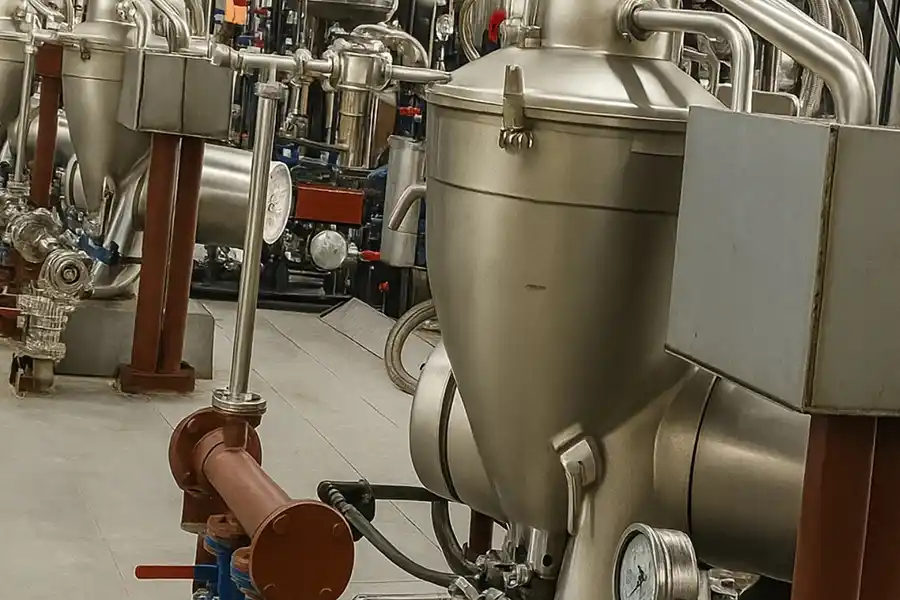
Reactor internals, pump shafts, valve stems, heat exchanger tube sheets and agitator rods in chloride, brine and dilute acid service.
Gr 2, Gr 5, Gr 12
Marine & Offshore
Propeller shafts, riser tensioners, seawater cooling hardware and subsea fasteners. Titanium does not pit in natural seawater and tolerates chlorination.
Gr 2, Gr 5 ELI, Gr 23
Medical Devices
Bone screws, dental implant blanks, surgical instruments and orthopaedic components to ASTM F67, F136 and ISO 5832-3.
Gr 2, Gr 12
Energy & Power
Condenser and turbine hardware, geothermal wellhead parts, desalination plant components and nuclear waste handling fixtures.
Gr 2, Gr 5
Precision Machining
Ground and turned rod to h9 tolerance for automatic lathe and Swiss-type CNC work, supplied straight to 0.5 mm per metre or better.
How every heat is verified before it ships
Certification is only as good as the sampling behind it. Our tensile and chemistry samples come from the same heat and the same rod as the delivered material, not from a reference lot, and the heat number follows the rod through every stage.
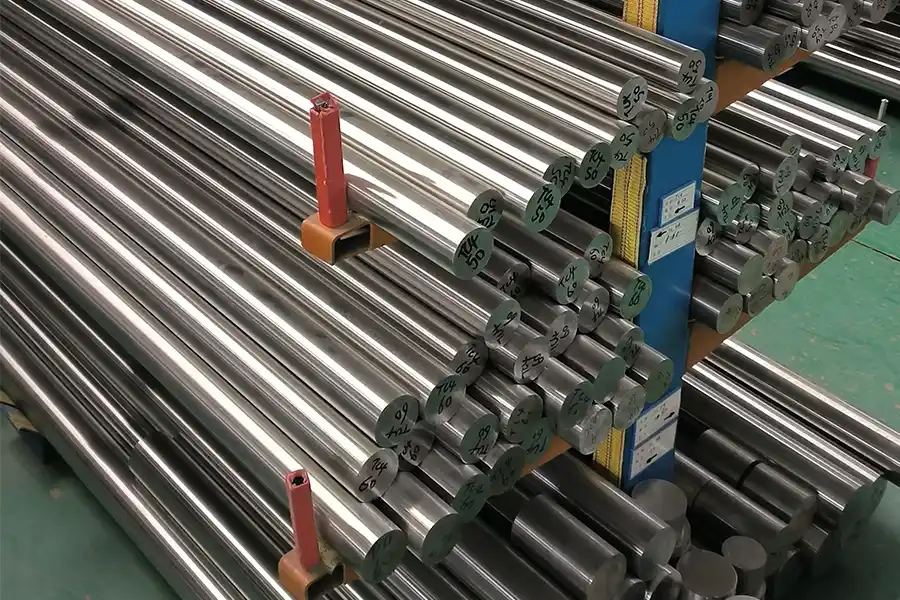
Inspection route
- Melt route
Double or triple vacuum arc remelt from certified sponge. Ingot chemistry taken at head, middle and tail. - Forging & rolling
Multi-pass forging below the beta transus for alpha and near-alpha grades, with intermediate annealing to break down as-cast structure. - Heat treatment
Mill anneal as standard. Solution treated and aged (STA) available for Grade 5 where higher strength is specified. - Non-destructive testing
Ultrasonic testing to ASTM E2375 or AMS 2631, liquid penetrant to ASTM E1417, and visual plus dimensional check on 100 percent of rod. - Mechanical verification
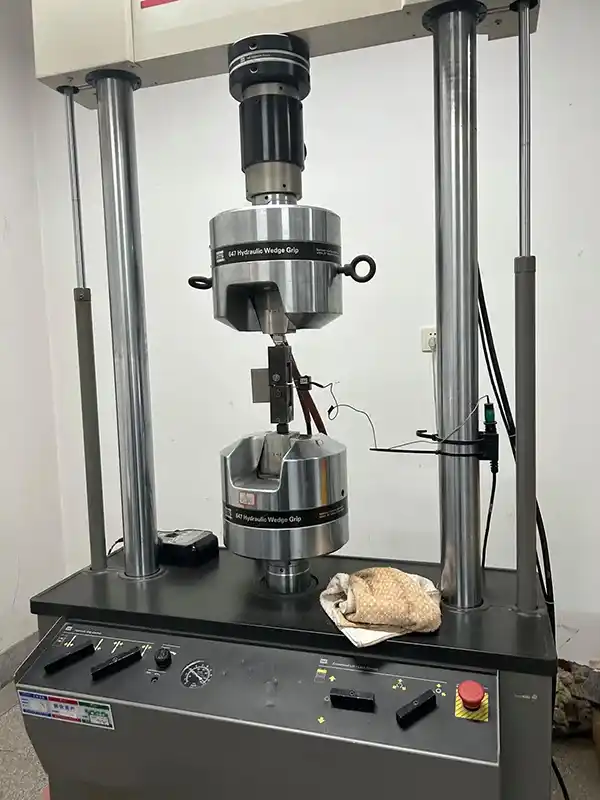
Tensile, hardness and, where specified, Charpy impact and bend tests taken from the same heat and the same rod as the delivery.
Frequently asked questions about titanium rod
The questions we are actually asked in RFQs, answered in enough detail that you can specify correctly the first time.
What is the difference between Grade 2 and Grade 5 titanium rod?
Grade 2 is commercially pure titanium with a minimum tensile strength of 345 MPa, chosen for corrosion resistance and weldability. Grade 5 is Ti-6Al-4V with a minimum tensile strength of 895 MPa, chosen where load carrying matters. Grade 2 costs less and is easier to machine and weld; Grade 5 carries roughly 2.6 times the strength at slightly lower density. If your part sees chlorides or oxidising acids and no significant structural load, Grade 2 is normally the right call. If it is a fastener, shaft or load path, specify Grade 5.
Which standard should I put on my purchase order?
ASTM B348 covers titanium and titanium alloy rods and billets and is the standard most international buyers quote. Pair it with the grade, the diameter and tolerance class, the condition (annealed is standard), and any supplementary testing. Aerospace orders add AMS 4921 for commercially pure rod, AMS 4928 for annealed Ti-6Al-4V rod, or AMS 4967 where the part will be solution treated and aged after rough machining. Medical implant orders reference ASTM F67 for CP grades or ASTM F136 for Ti-6Al-4V ELI. Chinese domestic orders may quote GB/T 2965 instead, and our mill issues certificates against both.
What is the minimum order quantity?
Stocked grades in common diameters ship from 50 kg with no minimum order value, and we can supply single rods for prototyping. Made-to-order grades, including Grade 7, Grade 9 and Grade 12, and any forging above 200 mm diameter, normally start at 300 kg because a full melt is required. Mixed-grade orders count toward the total weight, so a 300 kg basket of several grades is accepted.
How is titanium rod packed for export?
Rods are wiped clean, wrapped in VCI anti-corrosion paper, bundled with steel strapping over protective edge guards, and placed in fumigated wooden crates with the heat number marked on both the bundle tag and the crate. Small diameter rod under 20 mm is packed in cartons lined with foam. Crates are built for forklift handling, and long lengths above 4 m are packed in open timber frames. Every package carries a waterproof label with grade, heat number, diameter, length and net weight.
Can titanium rod be machined like steel?
Not with the same parameters. Titanium has low thermal conductivity, so heat concentrates at the cutting edge rather than leaving with the chip, and it work hardens under light cuts. Use sharp carbide tooling, a rigid setup, a cutting speed of roughly 40 to 60 m/min for Grade 2 and 20 to 35 m/min for Grade 5, a positive feed of at least 0.15 mm per revolution, and flood coolant at high pressure. Never let the tool dwell without cutting. Grinding needs an aluminium oxide wheel and light passes to avoid alpha case and surface burning.
Do you supply rods for medical implant use?
Yes. We supply Grade 23 (Ti-6Al-4V ELI) to ASTM F136 and CP grades to ASTM F67, both in the annealed condition with oxygen controlled to 0.13 percent maximum for the ELI grade. Implant rod is supplied with ultrasonic testing to ASTM F136 requirements, full traceability to the vacuum arc remelt ingot, and biocompatibility documentation on request. Please state the implant standard and the required test method when you enquire, because the melt route differs from industrial rod.
Tell us what you need and we will quote the same day
The more precisely you specify grade, diameter, length, condition and quantity, the more accurately we can price. If you only have a drawing, send that instead and we will read the specification from it.