
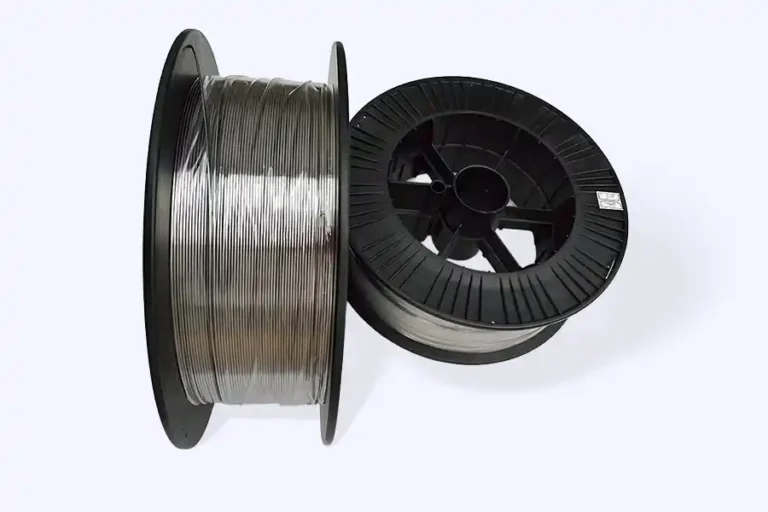
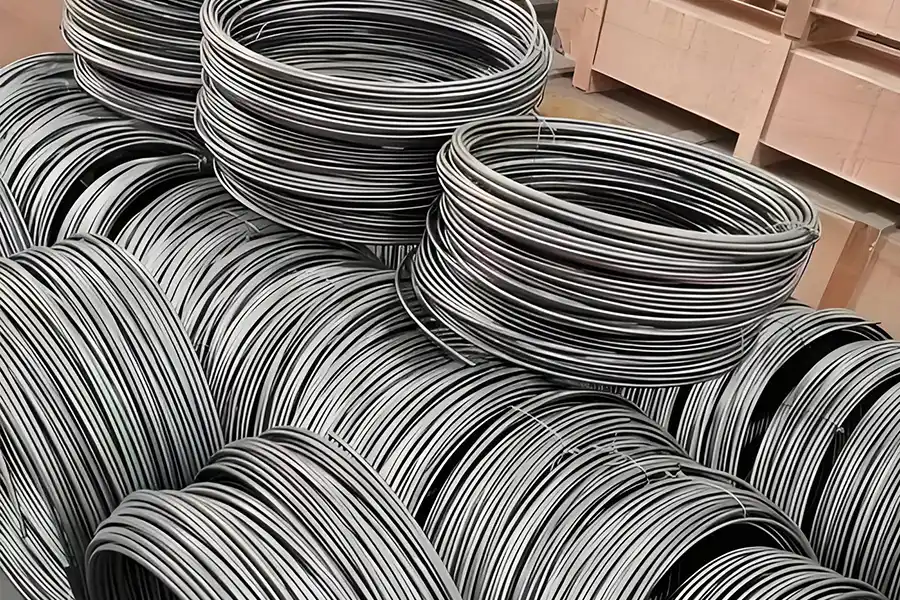
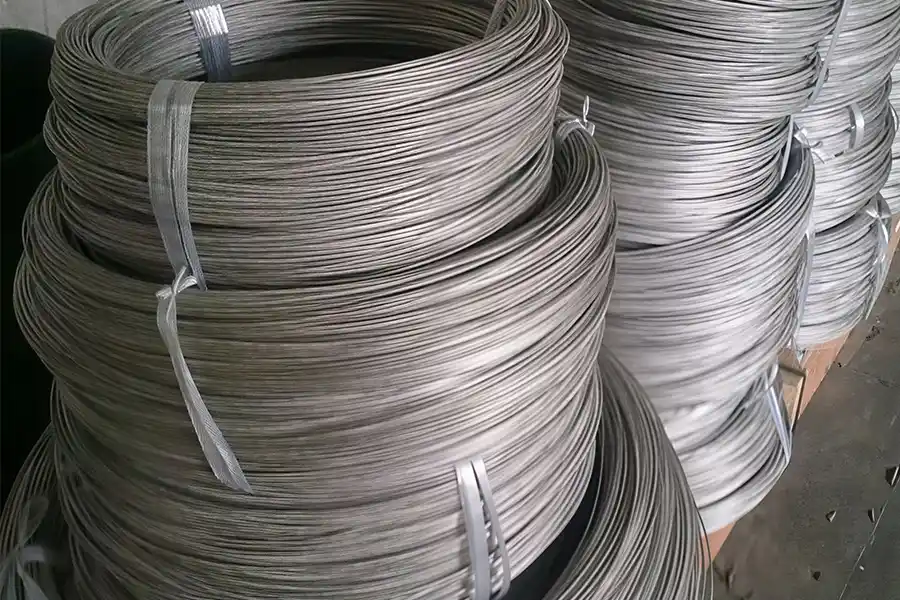
In short: Titanium wire is cold-drawn wire made from commercially pure titanium or a titanium alloy and supplied to ASTM B863. Buyers use it in four roles: welding wire, feedstock for machined or formed parts, spring and fastener stock, and the substrate for MMO-coated wire anodes. Qixin draws 0.5–6.0 mm wire in Baoji, China, and ships it annealed or in a specified cold-worked temper.
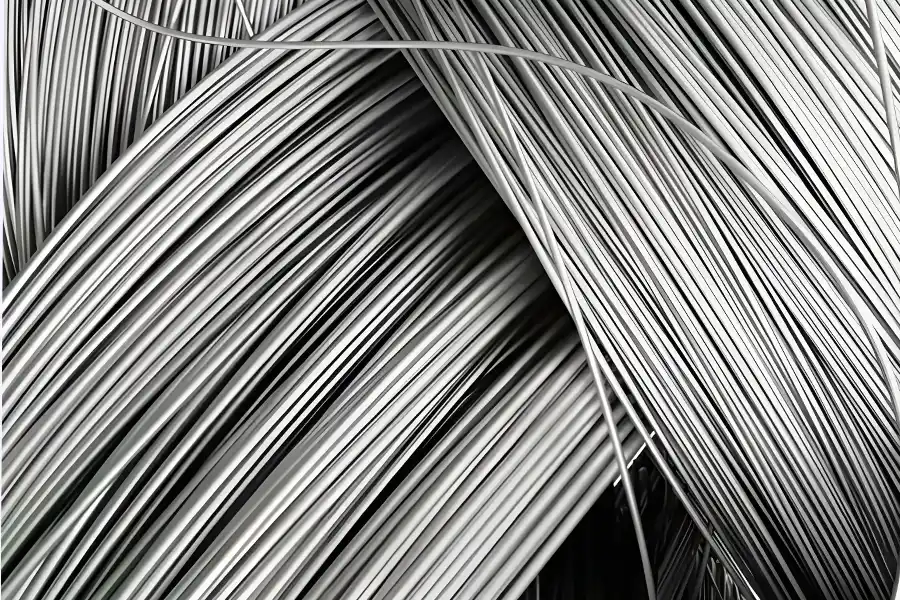
Titanium wire is produced by cold drawing. A hot-rolled wire rod is descaled, pointed and pulled through a series of carbide dies that step the diameter down; the wire is annealed between passes to restore ductility, then finished to the required surface and temper. Where titanium rod and bar is straightened and cut in larger sections, wire is delivered coiled — the form that lets it feed a TIG torch, a spring coiler, a medical wire former or a mesh loom without a secondary straightening step.
The grade you specify changes three things: tensile strength, corrosion behaviour, and how much cold reduction the wire will accept before it has to be re-annealed.
In the unalloyed grades, strength is set almost entirely by oxygen. Oxygen sits in interstitial solution and blocks dislocation movement, so the four commercially pure grades are the same metal at four oxygen levels: Grade 1 at 0.18 % maximum gives 240 MPa minimum tensile strength, Grade 2 at 0.25 % gives 345 MPa, and Grade 4 at 0.40 % reaches 550 MPa. Grade 2 accounts for most of the wire we ship, because it keeps the corrosion resistance and weldability of the pure grades at a strength that holds up in real hardware.
The alloy grades trade formability for strength. Grade 5 (Ti-6Al-4V) reaches 895 MPa annealed and is the choice where the wire is a load path — fasteners, springs, surgical instruments. Grade 9 (Ti-3Al-2.5V) sits at 620 MPa and still cold-forms well, which Grade 5 does not. Grade 7 adds 0.12–0.25 % palladium to a Grade 2 chemistry and resists reducing acids and crevice attack below pH 3; Grade 12 gets most of the same resistance from 0.3 % molybdenum and 0.8 % nickel at a fraction of the cost.
Temper matters as much as grade. Annealed wire is soft and ductile — the default for welding, coiling and heading. Cold-drawn wire carries the strength of the reduction it has seen, with lower elongation: that is the condition specified for springs, straight-length spokes and wire that must hold a set. State the temper, not just the grade, or you will receive the mill’s default anneal.
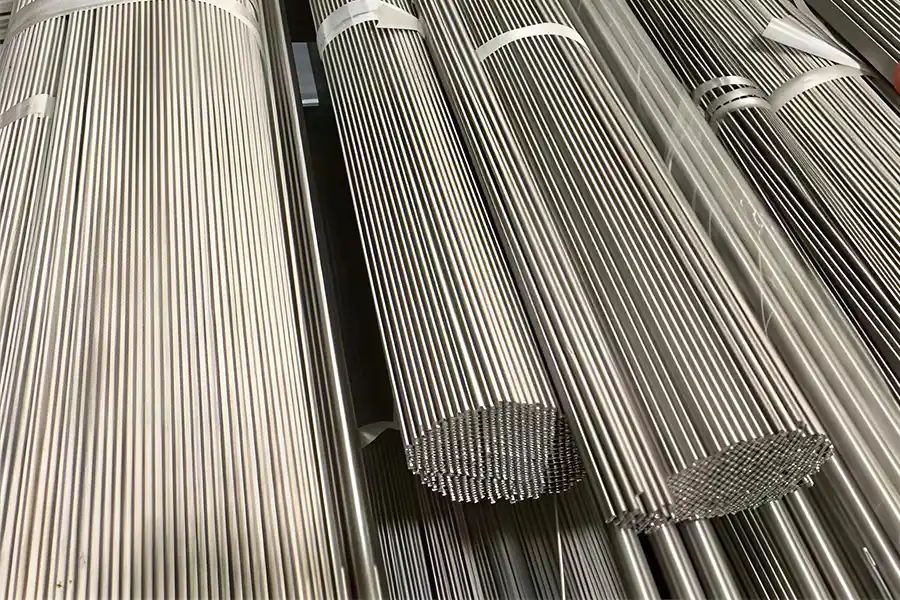
Minimum mechanical values are taken from ASTM B863 for wire in the annealed condition. Cold-drawn temper raises tensile strength and lowers elongation; specify it separately if the part depends on it.
| Grade | UNS | Tensile min | Yield min (0.2 %) | Elongation min | Typical wire use |
|---|---|---|---|---|---|
| Grade 1 | R50250 | 240 MPa | 170 MPa | 24 % | Mesh, woven screens, deep-formed parts, filtration |
| Grade 2 | R50400 | 345 MPa | 275 MPa | 20 % | Welding wire, anode substrate, general fabrication |
| Grade 3 | R50550 | 450 MPa | 380 MPa | 18 % | Intermediate strength, pressure hardware |
| Grade 4 | R50700 | 550 MPa | 483 MPa | 15 % | Springs, fasteners, high-strength CP parts |
| Grade 5 | R56400 | 895 MPa | 828 MPa | 10 % | Fasteners, surgical instruments, aerospace hardware |
| Grade 7 | R52400 | 345 MPa | 275 MPa | 20 % | Reducing-acid and chloride service |
| Grade 9 | R56320 | 620 MPa | 483 MPa | 15 % | Cold-formed tube, springs, bicycle and aerospace lines |
| Grade 12 | R53400 | 483 MPa | 400 MPa | 18 % | Heat-exchanger and chemical plant hardware |
Chemical composition, weight percent, maximum unless shown as a range:
| Grade | O | Fe | C | N | H | Alloying elements |
|---|---|---|---|---|---|---|
| Grade 1 | 0.18 | 0.20 | 0.08 | 0.03 | 0.015 | — |
| Grade 2 | 0.25 | 0.30 | 0.08 | 0.03 | 0.015 | — |
| Grade 3 | 0.35 | 0.30 | 0.08 | 0.05 | 0.015 | — |
| Grade 4 | 0.40 | 0.50 | 0.08 | 0.05 | 0.015 | — |
| Grade 5 | 0.20 | 0.40 | 0.08 | 0.05 | 0.015 | Al 5.50–6.75, V 3.50–4.50 |
| Grade 7 | 0.25 | 0.30 | 0.08 | 0.03 | 0.015 | Pd 0.12–0.25 |
| Grade 9 | 0.15 | 0.25 | 0.08 | 0.03 | 0.015 | Al 2.50–3.50, V 2.00–3.00 |
| Grade 12 | 0.25 | 0.30 | 0.08 | 0.03 | 0.015 | Mo 0.20–0.40, Ni 0.60–0.90 |
Titanium is the balance in every grade. Certificates report actual heat chemistry, not just compliance with the limits.
| Diameter | Process route | Standard tolerance | Surface | Supply form |
|---|---|---|---|---|
| 0.5–1.0 mm | Cold drawn, annealed, bright | ±0.02 mm | Bright, pickled | Spool |
| 1.0–3.0 mm | Cold drawn, annealed | ±0.03 mm | Pickled, bright | Spool or coil |
| 3.0–6.0 mm | Cold drawn from rolled rod, annealed | ±0.05 mm | Pickled, black | Coil or straight |
| 6.0–8.0 mm | Drawn or rolled, annealed | To drawing | Pickled | Straight |
Tighter tolerances, ground finishes and intermediate diameters are quoted on enquiry. Tolerances shown are our standard offering; the governing class on an order is the one written on the drawing or in the ASTM B863 callout.
Each spool and bundle carries grade, heat number, diameter, temper, net weight and surface condition. Coils are wrapped in VCI paper, foam-padded on the flange and crated for export.
| Field | Example |
|---|---|
| Standard | ASTM B863 |
| Grade | Grade 2 (UNS R50400) |
| Diameter and tolerance | Ø 1.6 mm, ±0.03 mm |
| Temper | Annealed |
| Surface | Pickled |
| Form and weight | 5 kg spools, 20 kg total |
| End use | TIG filler for Grade 2 vessels |
| Testing | Chemistry + tensile per heat |
Eight fields, one line each, and we can quote without a second round of questions. If you only have a drawing, send that.
| ASTM B863 | UNS | China GB | ISO 5832 | EN | Common name |
|---|---|---|---|---|---|
| Grade 1 | R50250 | TA1 | 5832-2 | 3.7025 | CP titanium |
| Grade 2 | R50400 | TA2 | 5832-2 | 3.7035 | CP titanium |
| Grade 3 | R50550 | TA3 | 5832-2 | 3.7055 | CP titanium |
| Grade 4 | R50700 | TA4 | 5832-2 | 3.7065 | CP titanium |
| Grade 5 | R56400 | TC4 | 5832-3 | 3.7165 | Ti-6Al-4V |
| Grade 7 | R52400 | TA9 | — | 3.7235 | Ti-0.2Pd |
| Grade 9 | R56320 | TA18 | — | 3.7195 | Ti-3Al-2.5V |
| Grade 12 | R53400 | TA10 | — | 3.7105 | Ti-0.3Mo-0.8Ni |
Equivalents are not interchangeable. GB TA2 and ASTM Grade 2 overlap closely, but their impurity limits are not identical, and ISO 5832-2 differs again on oxygen. If the drawing names one standard, we certify against that standard rather than substituting an equivalent.
| End use | Cite on the PO |
|---|---|
| General industrial wire | ASTM B863 + grade + diameter + temper |
| Welding filler | AWS A5.16 / A5.16M, ERTi-1 to ERTi-12 as applicable |
| Medical implant wire | ASTM F67 (CP) or ASTM F136 (Ti-6Al-4V ELI) |
| Surgical instruments | ASTM F899 |
| China domestic orders | GB/T 3623, chemistry to GB/T 3620.1 |
| European pressure work | certificate with the applicable PED route |
| Property | CP titanium (Grade 2) | Ti-6Al-4V (Grade 5) |
|---|---|---|
| Density | 4.51 g/cm³ | 4.43 g/cm³ |
| Melting point | 1668 °C | 1604–1660 °C |
| Elastic modulus | 105 GPa | 114 GPa |
| Thermal conductivity | 15.2 W/m·K | 7.2 W/m·K |
| Thermal expansion | 8.6 µm/m·K | 8.6 µm/m·K |
| Electrical resistivity | 0.55 µΩ·m | 1.75 µΩ·m |
| Magnetic permeability | Non-magnetic | Non-magnetic |
| Beta transus | ≈ 915 °C | ≈ 995 °C |